

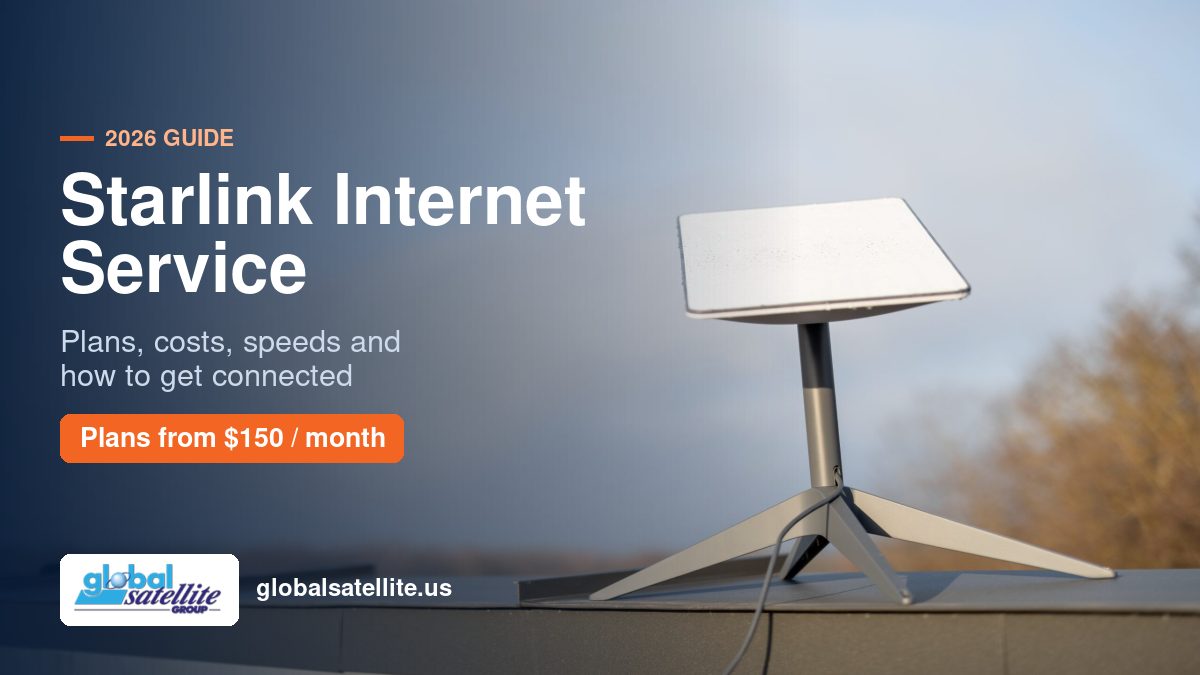
Starlink internet service has changed what is possible in places where cable, fiber and cell towers do not reach. A small dish, a clear view of the sky and a service plan are now enough to get broadband at a remote job site, on a yacht in open water, at a farm, a film location or an emergency operations center.
But “Starlink” is not one product. There are consumer plans, business plans with priority data, maritime plans that work in international waters, pay-as-you-go options and short-term rentals, each with different hardware, rules and costs. This guide explains how Starlink internet service works, what speeds to expect, which plan fits which use, what it really costs in 2026, and how to get connected.
Quick answer
Starlink internet service is satellite broadband from SpaceX, delivered by a constellation of more than 11,000 satellites in low Earth orbit (about 550 km up). It serves over 12 million customers in more than 160 countries and territories. You need a Starlink kit (dish and router) and a service plan. Through Global Satellite, business, maritime and flexible Starlink service starts at $150 per month (Pay As You Go), $199 per month for fixed sites on land (Local Priority) and $300 per month at sea (Global Priority). Rental kits start at $210 per week.
In this guide:
- What is Starlink internet service?
- How Starlink internet service works
- Speed, latency and reliability
- Starlink service plans compared
- Starlink hardware
- How much does Starlink internet service cost?
- Where Starlink is available
- How to get Starlink internet service
- Frequently asked questions
What is Starlink internet service?
Starlink is a satellite internet service built and operated by SpaceX. Instead of relying on a few large satellites parked about 35,786 km above the equator, like traditional satellite internet, Starlink uses thousands of small satellites in low Earth orbit (LEO), roughly 550 km above the Earth. As of October 2026, more than 11,000 Starlink satellites are in orbit, and in June 2026 Starlink announced it serves more than 12 million active customers across 160+ countries, territories and markets.
Because the satellites are about 65 times closer than geostationary satellites, the signal makes a much shorter round trip. That is why Starlink can support video calls, VoIP, cloud applications and streaming, which were difficult or impossible on older satellite systems.
| Factor | Starlink (LEO) | Traditional satellite (GEO) |
|---|---|---|
| Orbit altitude | About 550 km | About 35,786 km |
| Latency | Tens of milliseconds | About 600 ms or more |
| Real-time apps | Video calls, VoIP, remote desktop | Noticeable delay |
| Setup | Self-aligning dish, minutes to set up | Precisely pointed dish, often professional install |
How Starlink internet service works
Every Starlink connection has three parts:
- The Starlink kit: a flat, self-orienting dish (the user terminal) and a Wi-Fi router. The dish finds the satellites overhead automatically. On the Starlink Mini, the router is built into the dish.
- The satellite constellation: satellites in low Earth orbit pass overhead continuously. The dish hands the connection from one satellite to the next as they move across the sky, without the user noticing.
- Ground stations and the network: data travels between the satellites and ground stations connected to the internet backbone. Laser links between satellites also carry traffic across oceans and remote regions.
All the user needs is power for the kit and a clear view of the sky. Trees, buildings, masts and other obstructions can interrupt the connection, so correct installation matters as much as the plan you choose.
Speed, latency and reliability
Starlink speeds depend on the hardware, the plan, network demand in your area and the installation. As a guide:
- Home plans: Starlink advertises speeds of 400+ Mbps on its top US residential plan, Residential Max.
- Starlink Mini: the compact, portable kit delivers speeds of up to about 100 Mbps.
- Maritime: the Flat High Performance terminal delivers up to 220 Mbps at sea.
- Latency: typically tens of milliseconds, low enough for video conferencing and VoIP.
Two factors make the biggest difference to reliability. The first is obstructions: a dish with a fully clear view of the sky performs far better than one partly blocked by trees or structures. The second is priority data: business and maritime plans include priority data that is served ahead of standard consumer traffic when the network is busy. Heavy rain or snow can reduce speeds temporarily, but the service is designed to keep running in most weather. For more detail, read our guide to Starlink speed.
Starlink service plans compared
Starlink plans differ in three ways: where the terminal can be used, how much priority data you get, and what happens after that data is used. Consumer plans for homes and travel are sold directly by Starlink. Business, maritime and flexible plans are also available through authorized partners like Global Satellite, with hardware, activation and support in one place.
| Plan | Where it works | Data | Price from | Best for |
|---|---|---|---|---|
| Starlink PAYG | Global service | 10 GB included, then $5 per GB | $150/month | Occasional, seasonal and backup users |
| Local Priority | Within one country, including its territorial waters | 50, 100 or 500 GB priority data | $199/month | Offices, construction sites, farms, field teams |
| Global Priority (Maritime) | Worldwide, including the open ocean | 10 GB to 15 TB priority data | $300/month | Yachts, fishing fleets, workboats, offshore |
| Global Priority Unlimited | Worldwide, eligible IMO-registered cargo and tanker vessels | Unlimited, no throttling, no overage | $3,070/month (12-month plan) | Merchant vessels |
| Starlink Rentals | Shipped worldwide | Data plans from 50 GB | $210/week | Events, film crews, expeditions, emergencies |
| Residential and Roam (sold by Starlink) | Home address, or travel within supported areas | Depends on plan | About $55/month in select US areas | Households and personal travel |
Global Satellite prices in US dollars, as listed on our plan pages. Consumer plan prices are set by Starlink, vary by address and were checked in October 2026.
Residential vs business Starlink service
Residential plans are designed for a household at a single address. Business plans add priority data that is served ahead of residential traffic when the network is congested, along with options for multiple sites, vessels and fleets. For a company, the difference shows up at the busiest moments: a video call during peak hours, a cloud backup, or a point-of-sale system that cannot go offline.
What happens after your data allowance?
On maritime Global Priority plans, you choose how extra data is handled: pay per GB (from $2.50 to $7.00 per GB depending on the plan), buy 25 GB or 250 GB top-ups, or opt out and continue at limited speed. Our Starlink overage options page explains each choice. If you are wondering whether any plan is truly unlimited, read Is Starlink unlimited data?
Starlink hardware: which kit do you need?
Your plan determines where you can use the service. Your hardware determines how fast and how robust it is. The main options:
- Starlink Standard (Gen 3): the most common kit for homes, offices and fixed sites, with an integrated Wi-Fi router.
- Starlink Mini: a compact, portable dish with a built-in router, small enough for a backpack and powered by USB-C PD or 12V. Ideal for field teams, travel and backup. For all-day power off the grid, see the Star-Batt battery system for Starlink Mini.
- Starlink Performance (Gen 3): a rugged kit for demanding fixed and enterprise installations.
- Starlink Flat High Performance: a low-profile terminal built for vessels and vehicles, with speeds of up to 220 Mbps at sea.
Not sure which one fits? Our Starlink devices comparison sets out the differences side by side, and our team can recommend mounts, cabling and installation for your site or vessel.
How much does Starlink internet service cost?
The total cost of Starlink internet service has three parts:
- Hardware: the Starlink kit, bought once (or rented for short projects), plus any mounts, cables or power accessories.
- Monthly service: from $150 per month for PAYG, $199 per month for Local Priority on land and $300 per month for Global Priority at sea through Global Satellite.
- One-time and usage fees: for example, a $200 activation and configuration fee on Local Priority plans, and overage or top-ups when you use more than your allowance.
Three examples:
- A remote construction office using about 80 GB a month would typically choose Local Priority 100 GB at $240 per month, plus the $200 one-time activation.
- A yacht cruising seasonally in international waters needs a Global Priority maritime plan, from $300 per month, sized to the crew’s data use.
- A film crew on location for two weeks can rent a Standard Case + Battery kit for $560 plus a 100 GB data plan at $469.99, with no hardware to buy.
For every option and price in one place, see Starlink plans.
Need help choosing?
Get the right Starlink plan the first time
Tell us where you need to connect and how much data you use. A Global Satellite specialist will recommend the plan, kit and installation.
Where is Starlink internet service available?
Starlink is available in more than 160 countries and territories, and new markets keep opening. The United Arab Emirates, for example, approved Starlink service in March 2026. Availability still depends on local licensing, and some countries limit how the service can be used. In the UAE, for instance, using Starlink while moving on land is restricted, although maritime use is permitted.
At sea, Global Priority maritime plans work worldwide, including the open ocean. Local Priority plans only work within the country of registration and its territorial waters, and stop working once you leave them. Before you travel or deploy abroad, check that your plan covers your route. Starlink publishes an availability map on starlink.com, and our team can confirm the right plan for multi-country operations.
Who uses Starlink internet service?
- Businesses and remote sites: offices, warehouses, farms and facilities without fiber or reliable cable.
- Construction, mining and energy: temporary sites that need connectivity from day one.
- Maritime: yachts, fishing fleets, workboats and merchant vessels. See our Starlink Maritime guide.
- Emergency response and business continuity: backup internet when terrestrial networks fail. See our satellite emergency kit.
- Events, media and expeditions: short-term connectivity with Starlink rentals.
Starlink internet service: pros and cons
| Advantages | Limitations |
|---|---|
|
High-speed, low-latency broadband almost anywhere Fast setup with a self-aligning dish Plans for land, sea, travel and short projects Portable options like the Starlink Mini Works independently of local cable and cell networks |
Needs a clear view of the sky Speeds vary with network demand and location Priority data allowances on business plans Service depends on local licensing in each country Hardware and power are needed at every site |
How to get Starlink internet service with Global Satellite
- Tell us your use case: fixed site, vessel, fleet, travel or a short-term project, plus your location and expected data use.
- Choose your plan: PAYG, Local Priority, Global Priority, Unlimited for merchant vessels, or a rental.
- Get the right hardware: Standard, Mini, Performance or Flat High Performance, with mounts, cabling and power accessories.
- Activation and setup: we activate your service and support the installation.
- Ongoing support: plan changes, data top-ups and technical help from satellite specialists by phone and email.
Global Satellite Group has supplied satellite communications since 1974, with offices in the USA, France, Morocco, Gibraltar and the Cayman Islands. We work with businesses, maritime operators, government agencies, NGOs and individuals who need to stay connected where traditional networks do not reach.
Frequently asked questions
What is Starlink internet service?
Starlink is a satellite broadband service from SpaceX that uses more than 11,000 satellites in low Earth orbit to deliver high-speed, low-latency internet almost anywhere with a clear view of the sky. You need a Starlink kit and a service plan.
How much does Starlink internet service cost per month?
Through Global Satellite, Starlink service starts at $150 per month for PAYG (10 GB included), $199 per month for Local Priority on land and $300 per month for Global Priority maritime plans. Consumer plans sold directly by Starlink start at about $55 per month in select US areas. Hardware is purchased separately, or rented from $210 per week.
Is Starlink internet service unlimited?
It depends on the plan. Business and maritime plans include a priority data allowance, followed by per-GB overage, top-ups or reduced speed. Global Priority Unlimited for eligible merchant vessels has no data cap, no throttling and no overage.
Can I pause my Starlink service?
Yes, on flexible plans. Starlink PAYG through Global Satellite can be suspended, upgraded or downgraded on request, which suits seasonal and occasional users.
Can I use Starlink on a boat or while moving?
Yes, with the right plan and hardware. Global Priority maritime plans work worldwide, including the open ocean, and the Flat High Performance terminal is designed for use in motion. Some countries restrict in-motion use on land, so check the local rules.
Does weather affect Starlink internet service?
Heavy rain or snow can reduce speeds temporarily, but Starlink is designed to keep working in most weather. Obstructions such as trees and buildings have a bigger impact, so a clear view of the sky is essential.
Do I need a long-term contract?
Not necessarily. PAYG and Local Priority are monthly plans, rentals run from 1 to 4 weeks online, and Global Priority Unlimited for merchant vessels is available on 12-month, 6-month or month-to-month terms.
Get connected with Starlink
Whether you need internet for a remote site, a vessel, a fleet or a two-week project, the right combination of plan, hardware and installation makes all the difference. Explore our Starlink plans, call us at +1 (954) 459-3002 (worldwide) or +1 (954) 459-3000 (USA office), or request a quote online.
Prices and plan details are subject to change. Starlink is a trademark of Space Exploration Technologies Corp.