
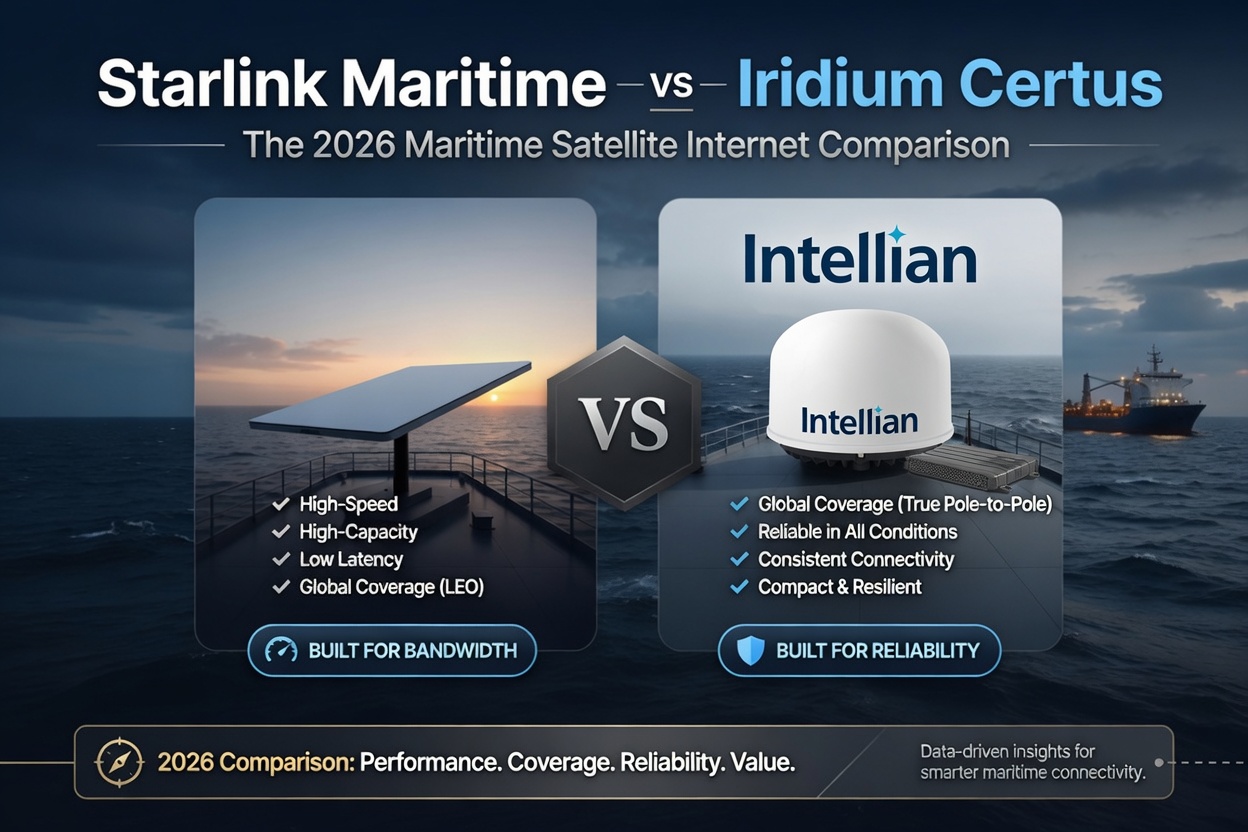
Choosing the right maritime satellite internet solution in 2026 is no longer a simple decision. With Starlink Maritime reshaping expectations around speed and cost, and Iridium Certus maintaining its reputation as the gold standard for reliability and emergency coverage, commercial vessel operators, fleet managers, and offshore crews face a genuinely difficult choice. This guide breaks down the real-world differences between Starlink Maritime and Iridium Certus — so you can choose the system that fits your vessel, your route, and your operational requirements.
Why maritime satellite internet matters more than ever
The maritime communications sector has undergone a dramatic transformation. Marine satellite internet is no longer a luxury reserved for large commercial vessels — it is now an operational necessity for fishing fleets, offshore energy platforms, expedition yachts, and cargo carriers alike.
According to industry data, more than 46,000 vessels were subscribed to L-band broadband and voice services in 2023, while Starlink had already signed connectivity agreements with nearly 300 cruise ships and thousands of commercial vessels by mid-2025. The question is no longer whether to invest in satellite connectivity — it is which system best serves your mission profile.
Starlink Maritime in 2026: broadband speed at sea
SpaceX’s Starlink Maritime has become the dominant conversation in maritime connectivity circles, and for good reason. With download speeds of 50 to 220 Mbps, latency comparable to terrestrial DSL, and a rapidly expanding constellation of over 6,000 LEO satellites, Starlink delivers broadband-class performance that was simply impossible at sea five years ago.
Starlink Maritime hardware options
For commercial vessels, the Starlink Flat High-Performance antenna is the recommended hardware. It is purpose-built for in-motion maritime use and offers significantly better stability in rough sea conditions compared to the standard residential dish. Global Satellite also supplies the Starlink Standard Gen3, which suits smaller vessels operating in calmer coastal waters.
Starlink Maritime strengths
- Speed: 50–220 Mbps download — sufficient for video conferencing, fleet management software, crew welfare streaming, and cloud applications
- Latency: 20–60ms, dramatically lower than GEO satellite systems (which average 600ms)
- Cost efficiency: Flat-rate billing models for commercial operators simplify connectivity budgeting
- Coverage expansion: US coastal waters, Caribbean, Mediterranean, and major Atlantic trade wind routes are now well covered
- Hardware integration: Compatible with SD-WAN platforms and hybrid network architectures
Starlink Maritime limitations
- Polar coverage gaps: Starlink does not yet provide consistent service above 85° latitude — a critical limitation for Arctic and Antarctic operations
- GMDSS non-certification: Starlink is not recognized by the IMO as a GMDSS-compliant distress communication system, meaning it cannot replace mandatory safety communications equipment
- Motion performance: While improving with firmware updates, reliable high-speed operation while underway at speed remains challenging in heavy sea states
- Geofencing risk: Some maritime operators have experienced service interruptions due to regulatory restrictions in certain territorial waters
Iridium Certus in 2026: the reliability benchmark
Iridium Certus represents a fundamentally different approach to maritime connectivity. Where Starlink prioritizes bandwidth, Iridium Certus prioritizes coverage certainty, regulatory compliance, and mission-critical reliability.
Built on the Iridium NEXT constellation — 66 active LEO satellites that provide 100% global coverage including both poles — Iridium Certus operates on L-band frequencies that penetrate weather, light structures, and the antenna obstructions that can affect higher-frequency systems. It is the only LEO satellite network formally recognized by the IMO for GMDSS distress and safety communications.
Iridium Certus hardware options
The Iridium Certus 700 is the flagship maritime terminal, delivering up to 704 kbps downlink and supporting three HD-quality voice lines simultaneously. It is designed for commercial vessels, offshore platforms, and any operator requiring a certified safety communications layer. Compact antenna footprint and simple installation make it a practical fit across vessel classes from fishing boats to tankers.
Iridium Certus strengths
- True global coverage: The only maritime satellite system covering 100% of the Earth’s surface, including polar shipping routes
- GMDSS certification: IMO-recognized since 2020 — the only LEO provider to achieve this, enabling full distress and safety communications compliance
- L-band weather resilience: Signal penetrates rain, heavy cloud, and sea spray with minimal degradation
- In-motion reliability: Maintains stable connectivity regardless of vessel speed, heading, or sea state
- Emergency SOS: Supports real-time GPS coordinate transmission and voice distress capability
- Low power consumption: Compact antenna draws significantly less power than Starlink hardware
Iridium Certus limitations
- Speed ceiling: 704 kbps is orders of magnitude below Starlink — unsuitable for video streaming, large file transfers, or bandwidth-intensive crew welfare applications
- Data costs: Per-megabyte pricing on Certus plans makes it expensive for high-volume data use
- Not a Starlink replacement: For operators who need crew internet, cloud applications, or fleet management dashboards, Certus alone is insufficient
Head-to-head comparison: Starlink Maritime vs Iridium Certus
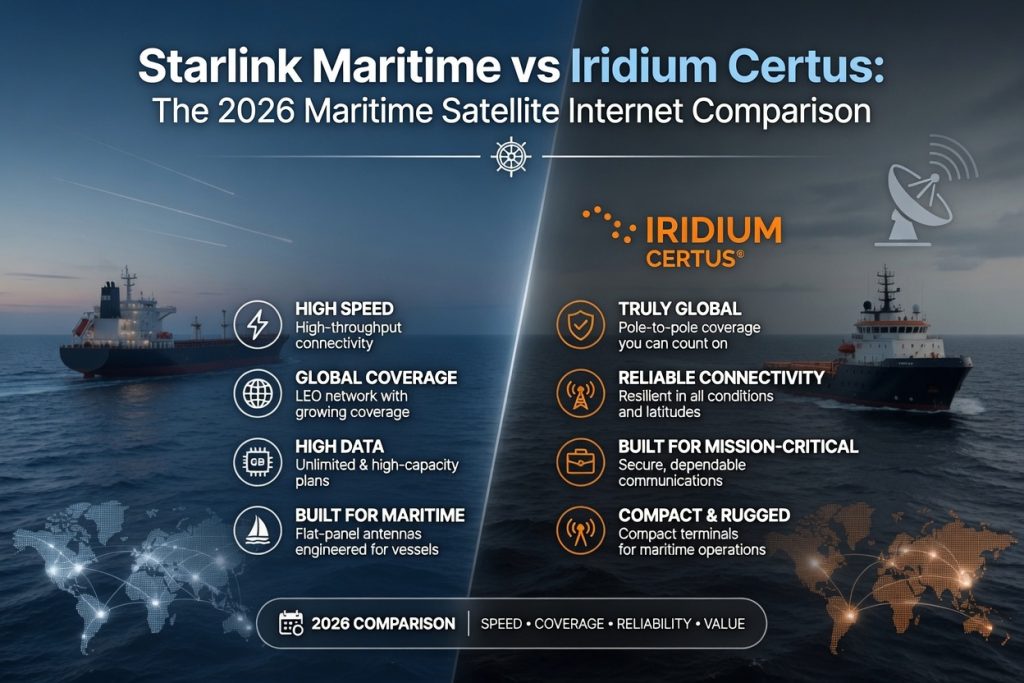
| Feature | Starlink Maritime | Iridium Certus 700 |
|---|---|---|
| Download speed | 50–220 Mbps | Up to 704 kbps |
| Latency | 20–60ms | ~500–600ms |
| Global coverage | ~95% (polar gaps) | 100% including poles |
| GMDSS certified | No | Yes (IMO recognized) |
| In-motion reliability | Moderate | Excellent |
| Weather resilience | Good | Excellent (L-band) |
| Voice lines | VoIP only | 3 HD voice lines |
| Best for | Crew welfare, fleet ops, cloud | Safety, emergency, polar, compliance |
The hybrid approach: why most commercial fleets use both
The most experienced maritime operators are not choosing between Starlink and Iridium Certus — they are deploying both as complementary layers in a hybrid network architecture.
A practical hybrid configuration for a commercial vessel looks like this:
- Starlink Maritime as the primary internet circuit — handles crew welfare, fleet management software, video conferencing, and cloud operations
- Iridium Certus as the always-on safety layer — handles GMDSS distress communications, emergency voice, and provides connectivity backup in polar regions or during Starlink outages
- SD-WAN orchestration (such as CommBox Edge) — intelligently routes traffic between both links, prioritizes operational data, and maintains continuity during failover events
This architecture is increasingly standard on tankers, offshore support vessels, fishing fleet leaders, and charter yachts operating globally. The combined monthly investment is higher, but the operational resilience and regulatory compliance it delivers justifies the cost for any vessel where connectivity is mission-critical.
What about emergency satellite communication?
For vessels that need a portable emergency communications capability — independent of installed ship systems — the Starlink Emergency Kit from Global Satellite provides a rapidly deployable satellite internet solution for distress situations, disaster response, and remote operations. It pairs the Starlink hardware with battery power in a ruggedized case, making it ideal for coast guard operations, humanitarian missions, and offshore emergency response teams.
For traditional satellite voice emergency backup, the Iridium satellite phone range remains the most widely trusted solution. With global coverage, an SOS button, and GPS position transmission, an Iridium handset is a critical item in any vessel’s grab bag — regardless of what primary connectivity system is installed.
Choosing the right maritime satellite internet plan
Hardware is only part of the equation. Airtime plans for both Starlink Maritime and Iridium Certus vary significantly depending on vessel type, operational region, data volume requirements, and contract length. Key considerations include:
- Data volume: How much data does your vessel consume monthly? Starlink flat-rate plans suit high-volume users; Iridium per-MB pricing suits low-volume safety-only use
- Operational region: Do your routes take you above 70° latitude? Iridium is mandatory. Mediterranean and Atlantic routes? Starlink performs well
- Crew size: Larger crews have higher welfare internet demands — factor crew-to-bandwidth ratios into your plan selection
- SOLAS/GMDSS compliance: Commercial vessels subject to SOLAS must maintain certified distress communication capability regardless of primary internet system
- Contract flexibility: Both systems offer month-to-month and annual commitments — the right structure depends on your operational calendar
Global Satellite Group: maritime connectivity expertise since 1974
Global Satellite Group has been serving commercial maritime operators for over 52 years from its base in Fort Lauderdale, Florida. As an authorized reseller of Starlink Maritime, Iridium Certus, Inmarsat FleetBroadband, and KVH maritime systems, Global Satellite provides independent, network-agnostic advice tailored to each vessel’s specific requirements.
Whether you are outfitting a single offshore support vessel, standardizing connectivity across a commercial fishing fleet, or building a hybrid satellite architecture for a global cargo carrier, the Global Satellite technical team can design, supply, activate, and support the right solution.
Explore our full range of marine satellite internet solutions or contact our maritime specialists to discuss your vessel communication requirements.
Frequently asked questions
Can Starlink replace Iridium Certus on a commercial vessel?
No. Starlink cannot replace Iridium Certus for GMDSS-regulated distress communications. Starlink is not IMO-recognized as a GMDSS provider. Commercial vessels subject to SOLAS requirements must maintain a certified distress communication system — Iridium Certus is the only LEO option that qualifies.
What is the best maritime satellite internet for a commercial fishing fleet?
For most commercial fishing fleets, a hybrid configuration works best: Starlink Maritime for crew welfare and operational communications, paired with an Iridium Certus terminal or handheld Iridium satellite phone for emergency backup and polar coverage. The optimal balance depends on your fishing grounds, fleet size, and flag state requirements.
How does Iridium Certus pricing compare to Starlink Maritime?
Iridium Certus plans are typically priced per megabyte or per voice minute, making them economical for low-data safety use but expensive for high-volume internet. Starlink Maritime commercial plans use flat-rate billing structures. Contact Global Satellite for current pricing on both systems tailored to your vessel profile.
Does Starlink work while a vessel is underway?
Yes, with caveats. The Starlink Flat High-Performance antenna is designed for in-motion maritime use and performs well at typical vessel speeds. However, heavy sea states, high pitch and roll, and obstruction of the dish can cause brief interruptions. For vessels operating in severe offshore conditions, Iridium Certus provides more consistent in-motion reliability.