
The maritime communications sector has changed rapidly with the global expansion of Low Earth Orbit (LEO) satellite constellations. Traditional maritime VSAT systems that once struggled with latency, expensive bandwidth structures, and regional limitations are now being challenged by a new generation of high-performance connectivity solutions.
For commercial fleets, offshore operators, tanker companies, and IMO-registered cargo vessels, Starlink Maritime is redefining what shipboard connectivity can deliver. With lower latency, significantly faster throughput, and scalable fleet deployment options, Starlink is becoming a core component of modern vessel IT infrastructure.
Fleet managers and maritime IT directors are increasingly deploying Starlink not as a standalone internet system, but as part of a fully integrated hybrid network architecture that combines LEO broadband, SD-WAN optimization, cybersecurity layers, and L-band emergency redundancy.
This guide explains how commercial operators are deploying Starlink Maritime in 2026 and why many fleets are transitioning away from legacy VSAT-only environments.
Starlink Maritime: The Merchant Vessel Unlimited Program

What Is the Merchant Vessel Unlimited Program?
The Merchant Vessel Unlimited Program is designed specifically for commercial maritime operators requiring continuous high-capacity connectivity across international shipping routes.
Unlike consumer-grade maritime plans, this enterprise-focused solution provides scalable bandwidth management for operational traffic, crew welfare services, cloud applications, and fleet-wide communications.
For commercial fleets operating globally, one of the biggest operational advantages is predictable bandwidth allocation combined with flat-rate billing structures.
Key Benefits of the Merchant Vessel Unlimited Program
- No data throttling
- Priority global maritime data access
- Flat-rate monthly subscriptions
- Designed for commercial shipping operations
- Optimized for fleet-wide deployment
- Improved operational bandwidth consistency
- Lower latency compared to traditional GEO VSAT systems
For maritime IT departments, predictable monthly operational costs simplify connectivity budgeting while reducing unexpected overage charges commonly associated with legacy satellite services.
Why Commercial Fleets Are Transitioning to Starlink Maritime
Many operators are adopting Starlink Maritime because of the operational limitations of traditional geostationary VSAT systems, including:
- High latency affecting cloud applications
- Expensive bandwidth structures
- Regional beam switching complications
- Congestion during peak operational windows
- Slow upload performance
LEO architecture dramatically reduces latency by positioning satellites much closer to Earth compared to geostationary systems.
For vessels running modern cloud-based fleet management systems, remote diagnostics, video conferencing, VoIP services, and real-time operational reporting, lower latency significantly improves onboard productivity.
Hardware Breakdown: The Starlink Performance (Gen 2) Kit
Why the Starlink Performance Kit Matters Offshore


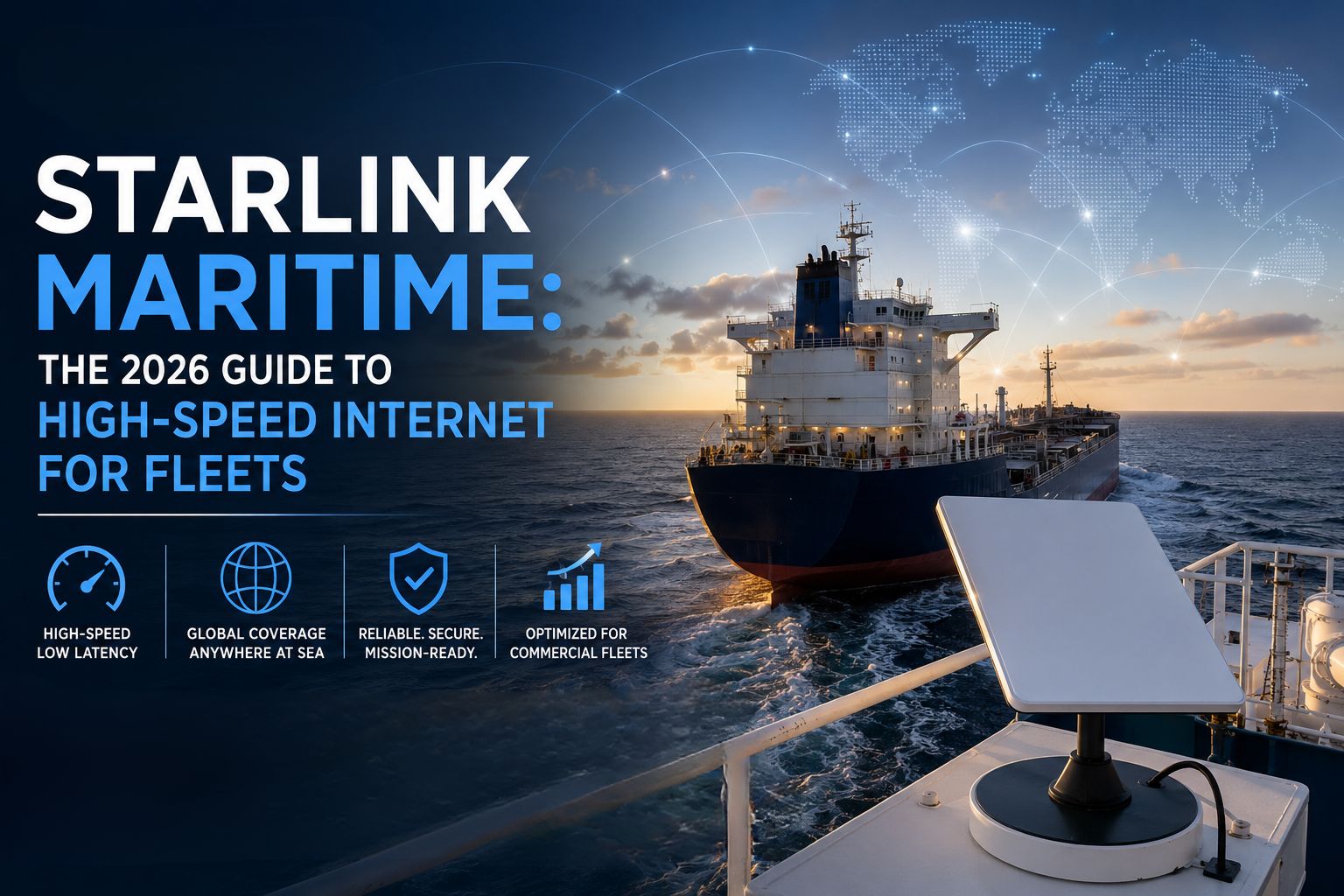
The Starlink Performance Kit is specifically engineered for high-demand mobility and harsh environmental conditions commonly encountered at sea.
Unlike residential hardware, the Starlink Performance (Gen 2) Kit is built for:
- Continuous maritime operation
- Extreme weather environments
- Heavy vessel vibration conditions
- Salt-air exposure
- Expanded sky visibility and satellite tracking
Key Technical Advantages
- Ruggedized commercial-grade construction
- Wider field of view for improved satellite acquisition
- Enhanced thermal management
- Higher reliability during vessel movement
- Optimized performance in rain and rough-sea conditions
For merchant vessels, offshore support ships, tankers, and commercial fishing fleets, the Performance Kit provides significantly more operational stability than standard residential hardware.

FREE Hardware Promotion for Commercial Fleets
Qualified operators can secure a FREE Starlink Performance Kit when committing to a 12-month Merchant Vessel Unlimited Program subscription.
This promotion allows fleets to reduce upfront deployment costs while accelerating migration toward high-speed maritime internet infrastructure.
Fleet eligibility depends on operational profile, deployment volume, and routing requirements.
The Importance of Network Integration & SD-WAN
Starlink Should Not Operate as a Standalone Maritime Network
One of the most common deployment mistakes in maritime connectivity is treating Starlink as an isolated internet circuit.
Commercial maritime operations require resilient, policy-driven network architectures capable of handling:
- Failover automation
- Traffic prioritization
- Cybersecurity enforcement
- Application-aware routing
- Multi-WAN management
- Fleet-wide visibility
This is where Commbox Edge integration becomes critical.
Why Commbox Edge Matters for Maritime Fleets


The Commbox Edge platform enables fleets to integrate Starlink connectivity into a centralized SD-WAN and cybersecurity framework.
Core Benefits of Commbox Edge Integration
- Intelligent WAN traffic management
- Automated failover between satellite links
- Firewall and network security enforcement
- Bandwidth optimization for operational applications
- Crew welfare traffic separation
- Centralized remote fleet management

For commercial fleets operating globally, SD-WAN orchestration ensures bandwidth efficiency while maintaining operational continuity during network degradation or satellite interruptions.
Maintaining L-Band Redundancy Remains Essential
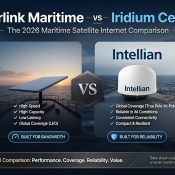
While Starlink Maritime provides exceptional broadband performance, commercial fleets should still maintain independent L-band backup systems for mission-critical emergency communication.
Recommended backup technologies include:
- Iridium
- Inmarsat
L-band systems remain essential because they provide:
- Highly reliable low-bandwidth communication
- GMDSS support pathways
- Emergency distress capability
- Weather-resilient connectivity during severe maritime conditions
Modern commercial vessels increasingly deploy hybrid architectures combining:
- Starlink for primary broadband connectivity
- SD-WAN optimization platforms like Commbox Edge
- L-band systems for emergency redundancy
This layered communication strategy significantly improves resilience and operational uptime.
Managing Global Installations & Support
Why Working with a Certified Maritime Integrator Matters
Deploying Starlink Maritime across commercial fleets requires more than simply activating hardware.
Fleet operators must address:
- Vessel installation logistics
- Network integration
- Firewall configuration
- Traffic shaping
- International shipping coordination
- Remote troubleshooting
- Fleet-wide airtime management
Working with a certified maritime satellite communications integrator ensures deployments are engineered correctly from the beginning.
Global Satellite Group Fleet Support Capabilities
Global Satellite Group supports maritime deployments with:
- 24/7 global technical support
- Fast international shipping
- Remote activation assistance
- Fleet-scale deployment coordination
- SD-WAN integration guidance
- Offshore troubleshooting support
- Multi-vessel provisioning services
For operators managing cargo vessels, tanker fleets, offshore service vessels, and expedition fleets, continuous technical support availability is critical for minimizing operational downtime.
For additional maritime network standards and cybersecurity guidance, operators can also review resources from the International Maritime Organization (IMO) and the U.S. Coast Guard Navigation Center.
Starlink Maritime as a Maritime VSAT Alternative
Comparing Legacy VSAT to Modern LEO Connectivity
Many fleet operators now evaluate Starlink Maritime as a practical maritime VSAT alternative because of several operational advantages.
Advantages Over Traditional GEO VSAT
- Lower latency
- Faster download and upload speeds
- Simplified deployment
- Better support for cloud applications
- Improved crew welfare internet access
- Reduced bandwidth congestion
However, experienced maritime IT directors understand that the optimal solution is often hybrid rather than replacement-only.
The most resilient fleet architectures combine:
- LEO broadband connectivity
- GEO backup capacity
- SD-WAN orchestration
- L-band emergency communications
This approach maximizes uptime while reducing single points of failure.
Upgrade Your Fleet Today
Commercial maritime connectivity has entered a new operational era. Fleets relying exclusively on legacy VSAT systems increasingly face challenges related to bandwidth efficiency, latency, crew expectations, and cloud application performance.
With the Merchant Vessel Unlimited Program, commercial operators can deploy scalable high-speed maritime internet while maintaining predictable operational costs and enterprise-grade network management.
Fleet managers interested in eligibility for the FREE Starlink Performance Kit promotion and the Merchant Vessel Unlimited Program can contact Global Satellite Group directly for a strategic consultation.
Contact Global Satellite Group
- Email: support@globalsatellite.us
- Phone: +1-954-459-3002
Global Satellite Group provides global deployment coordination, 24/7 technical support, SD-WAN integration guidance, and commercial maritime connectivity solutions for fleets operating worldwide.
For advanced fleet redundancy planning and hybrid network architecture strategies, CEO Martin Fierstone is also available to discuss custom commercial fleet communication solutions tailored to operational routing requirements.